Showing posts with label solar. Show all posts

Tuesday, June 4, 2013

Building Permit: RECEIVED! Time to prep the site.

As the title of this post implies, as of May 30 we now have our building permit! HOORAY! Now that we finally have the go-ahead, we have begun work marking and leveling the site.

We started out simply by scraping away topsoil around the approximate footprint of the house. (You can see we have also had a bunch of lumber delivered for forms we will eventually build for when the footers are to be poured.) Next we placed stakes at the corners of the house, which we made sure were accurate by measuring lengths, widths, and diagonals.

That makes it sound nice and easy to place the corners, when in fact it was a lot of work, particularly because we want to make sure we are oriented as correctly as possible to solar south for when the solar array is installed. We used several different methods to make sure our alignments were correct: aligning to the shadow of a long (over 15'!) vertically level stick at exactly solar noon (as determined from sunrise/sunset times on a given date... but even those aren't entirely accurate due to varying definitions of true sunrise/sunset); measuring against magnetic north using the correct declination as obtained from the NOAA website; and even a little experiment using a giant pendulum. It turns out that all these methods were accurate to within about a half a degree of each other, and we couldn't really hope for better accuracy than that. After initially placing the corners, we hung string to make sure we were aligned to solar south and made adjustments as necessary until we had the most accurate and agreeable lengths, widths, diagonals, and alignments as we could realistically achieve. Phew!
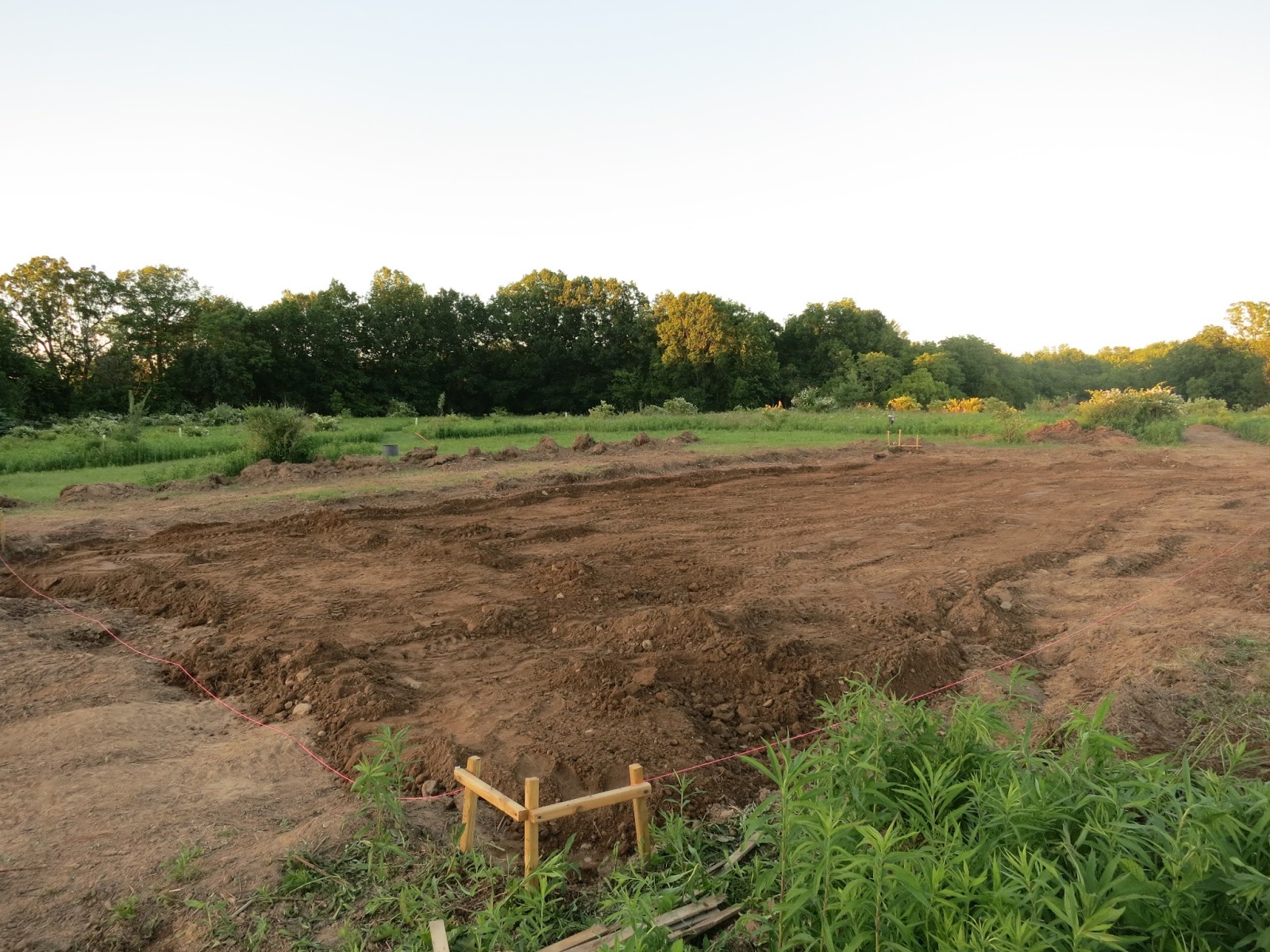

Now that we have the corners determined and the site relatively level (by sight only at this point), the next step is to determine what's truly level. We will do this by using a water level, which works on the principle that water always tries to find its own level. By filling a large bucket in the center of the area with water and filling a flexible tube with said water (with absolutely no bubbles), we can mark the water level on the tube and use that to determine a constant height in each of the corners. And, voila! We will have a level plane to work from. After that, we'll use the plane to mark out trenches and START DIGGING!

Updated budget:
+$504.80 - $10/sq ft for the building permit fee plus a $300 recreational fee
TOTAL SPENT SO FAR: $40,758.09

Friday, January 4, 2013

This just got real.

This morning, Matt and I stopped by Roth Green Energy to firm up some details about the geothermal and solar PV systems they quoted us, as well as put in down payments to lock in our contracts. We were greeted by coffee and donuts (they got them just for us!) and enjoyed another really great meeting. In a previous post about estimates I promised to go into more detail about the quotes we received, which I can follow through with now that we've locked in their services.

Geothermal
Considering the planned size of our house, it was determined both by us as well as independently by the folks at Roth that a 2-ton system would suffice. Not only will the system supply heat for our house, but it will also supply domestic hot water (DHW). After some thought, we decided to go with the in-slab heating due to its efficiency, quietness, even heating, and the fact that we won't have to spend the time and money to construct a subfloor as originally planned with the baseboard heaters. Below is the scope of the project:
So, the bottom line: Total Geothermal $33,810.97
We put down a 30% down payment today of $10,143.29(!), which is the same amount we can expect to get back thanks to a 30% tax credit. So the total out of pocket is expected to be $23,667.68.

Solar
As far as solar panels are concerned, we figured: go big or go home. Since we are hoping to go net zero, we had to plan for a large PV array to cover all our energy consumption needs, which will be large since everything will be electric. We used a couple different approaches to project our total consumption, including estimating from my parents' electric bill (since we have similar habits, and their bill includes electric appliances and a well pump); estimating using our own current electric bill plus what we can expect from adding in electric appliances & a well pump; and using a worksheet provided by NYSERDA that included a breakdown by appliance. All three methods were surprisingly consistent with each other, and estimated a total usage of roughly 10,000 KWH/year. We also added in an additional 2,000 KWH/yr for an anticipated electric car (eventually). Roth Green Energy came back with the following 12,480(!) watt grid-tied PV system, complete with all materials, engineering/submittals, software, programming, installation and wiring, system commissioning, start-up, check out, and owner training:
  • Supply and install 48 Solar World 260W mono panels, roof mounted on front roof - brand new & 100% made in the USA!
    • 2 strings of 12 panels
  • Provide 2 Sunny Boy 6000US STD inverters
  • Production meter
  • Monitoring Package
  • Solar mount roof racking system
  • Provide wire, conduit string combiner, system disconnect, and miscellaneous electrical components to complete the installation
There are all kinds of incentives for solar, including grants, rebates, and a tax credit:
                 Project Cost                       $45,000.00
                 NYSERDA Grant                 ($10,500.00)
                 Initial Costs                        $34,500.00
                 Federal tax credit (30%)    ($10,350.00)
                 NY State rebate                ($5,000.00)
                 Total out of pocket           $19,150.00

We were shocked to see that, thanks to so many incentives, the total out of pocket cost of such a huge PV array is under $20,000. We still recognize that it is a huge investment that will take many years to recoup the costs, but seriously: HOW COOL IS THAT??!? Some people spend money on cars, some people spend money on traveling... I'm happy to invest in solar photovoltaics. Anyways, it was important to put in a down payment today so that they could get started on the paperwork, since it can take months to get it all approved (and boy are we glad they're doing all the paper pushing for us!!). We put in a 35% down payment towards the total project cost, meaning $15,750,00.

Yikes, we wrote two huge checks today :-O ... That fact is still sinking in. These are just the first two of many that are sure to come (or go, I suppose is more accurate). It feels scary to part with so much so quickly, but we are really excited about what this money is going towards. We feel we'll be setting a really great example and are excited to be pioneers in really committing to green energy. We are very happy that we've chosen Roth Green Energy for our energy needs and feel confident they'll do a great job!


Updated budget:
Deposit for Geothermal: $10,143.29
Deposit for Solar: $15,750.00
Total spent so far: $27,703.29

Monday, December 10, 2012

Our first estimates!

Up until now we have spoken with a number of companies regarding green energy solutions, but have not had a lot come of it. Some companies don't really seem that knowledgeable; some seem to have more of a "me too" kind of approach. Or, some companies don't seem very enthusiastic about working with us, and aren't necessarily receptive to design questions. One such company was one we had a great, informative, and exciting conversation with at Greentopia, but now when it comes time to move forward things don't feel so friendly anymore. What gives? Don't people want our business? Don't they think we are serious?

Well, I guess that just goes to show that those are not the right companies for us. At any rate, ten days ago we met with Roth Green Energy, a division of Leo J. Roth corporation. We actually got connected to them through my searches for a metal roof installer, during which I found Leo J. Roth Corp. These guys seemed like everything we're looking for - the gentleman I spoke to was very knowledgeable, answered all my questions, and gave me a lot of great information about the types of metal roofs I should consider for solar panels - except, unfortunately, it turns out they are a commercial installer and their insurance does not cover residential. Rats. Even so, the helpful gentleman told me about their Green Energy division, which led to our meeting 10 days ago. At this meeting we learned all about the services Roth Green Energy offers, including geothermal and solar. Much of our researched knowledge was confirmed and our questions answered. Even better, their engineer is part of the installation process, which makes us more confident in the quality of their work. And best of all, we chatted at-length about our overall house plans, which they thought were very clever, logical, and well-informed. It felt nice to finally have some of our ideas reinforced, rather than being looked at like we're crazy. They even took us on a tour of their facilities, even though it was a Saturday. (For future reference, they also have a crane for hire. That could come in handy later.) The meeting overall was incredibly encouraging and invigorating - now this is more like it!

Based on our discussions in that meeting, we asked for estimates for a geothermal radiant baseboard system, a geothermal radiant slab system, and as large and powerful a solar array could be achieved on the dimensions of our south-facing roof, aiming for ~10kw. Earlier this evening we met up at the site to go over the topography, after which we went to my parents' house to discuss the project estimates. Since we haven't signed anything official or made any deposits yet, I won't go into detail about the quotes, but I will say that we were very happy with them. Matt and I were both expecting the out-of-pocket expense for the solar to be three times as much as estimated, so that came as a very pleasant surprise. The geothermal quotes were pretty much as expected, though the part that surprised us was that the in-slab radiant actually came out slightly cheaper in comparison to baseboard. We had expected the in-slab to be more expensive, so now we have more to consider when it comes to deciding which radiant approach to take. 

We are now quite certain that we will be getting geothermal and solar, both installed by Roth Green Energy. Next up, we need to decide whether we want to go with radiant slab or baseboard heat, after which we can agree on the contracts, put down deposits, and finalize drawings and parts lists for final review. At that point I'll go into more detail about the systems we're going with and the reasoning behind them.


So, readers: Does anyone have radiant in-floor heating? The fact that it is so permanent and inaccessible makes me kind of nervous. How likely is a slab on-grade to ever crack; and if it does, what possible ramifications would there be on the in-floor radiant system and on the house structure as a whole? Also, how do we deal with doorways or floor transitions (i.e., wood to carpet, etc.) where something would need to be nailed down? I must admit that I am leaning towards the radiant slab, but it complicates things to a point where we will have to rely on others to do the job (whereas before we were planning to do much of the concrete work ourselves).

Tuesday, September 25, 2012

Questioning the Status Quo

We already have some overreaching house plans in mind which would obviously have major implications on what other decisions we make. After visiting the Greentopia EcoFest and doing other research, we have a better idea for some of the basic specifications we plan to employ (with a short explanation of our reasoning):
  • 30-35º roof pitch on a true-south facing roof (to maximize solar panel efficiency; numbers are specific to our region)
  • Raised seam steel roofing (allows for solar panel attachment without any drilling or nailing; requires practically no maintenance)
  • Single level floorplan, no attic or basement (keeps costs way down, uses fewer materials; maximizes space; more efficient for heating)
  • Radiant heating (uses less energy; maintains more constant/consistent temperature)
  • Basic rectangular shape (no unnecessary corners which create more work, more places to seal/insulate, etc.; full 180º-270º views from all sides/corners with no blocking)
  • 8' ceilings, no cathedral or vaulted ceilings (height of drywall, so allows for efficient material usage; no wasted space, more efficient for heating; though, may want to also investigate other heights since other dimensions are available)
  • Trusses to support the roof (sturdy, allows for next bullet point)
  • ~4ft overhang of roof on N/S sides (will block summer sun but allow winter sun angle; blocks rain, may not even need gutters)
  • <2,000 sq ft (we really have no need for anything more than that... even that much seems rather extravagant for us)
  • Lots of insulation and sealing (obvious reasons; insulation material undecided as of yet)
  • And then all the obvious things you can get energy efficient upgrades on - triple pane windows, front loading washer/dryer, energy star refrigerator, low flush toilet, low flow shower head, CFL/LED lighting, etc. (again, obvious reasons)

You might notice that some of the things described above sound a little bit goofy, or at least unconventional. Through our research and brainstorming we have had to do quite a lot of questioning the norm. If you had asked us a few months ago what we wanted, our answers probably would have been quite different: 2 floors, attic and basement, 2 or 2.5 baths, so on. But along the process we have been forced to reassess what is really necessary and what really makes sense. Do we really need an attic and basement, or is that just what we're used to? What is the real motivation behind 2 floors, and is building up really necessary when you have basically limitless surface area to spread out over? How much does the house really matter in comparison to the "estate" as a whole? Our adventure is growing from your basic building-a-dream-home to a full on experiment (which we see as a good thing).

This list is by no means comprehensive, nor is any of it set in stone. This is basically an overview of many of the ideas we have come up with that seem to maximize efficiency, solve problems, and follow logic. Many of these ideas will probably get their own blog posts with more detailed explanations of how we came up with them. Any feedback, suggestions, ideas, or constructive criticisms you may have now or along the way are most certainly welcome in the comments - after all, we are still just feeling this out ourselves. Not all of our ideas are necessarily good ones.

The little icon for this blog is actually drawn to scale according to ideas described above,
including a 33.7º roof pitch, 4' overhang, and 8' ceilings.