This might be the most disappointing blog entry yet, since I named it "big reveal" but I reveal nothing by way of pictures. Sorry, we lapsed on photo documenting duties this weekend! Nonetheless, that doesn't make our work any less noteworthy.
Matt and I both had Friday off of work (our 5 year wedding anniversary :-) ) and we used the morning as an opportunity to do a little work on the site. Unfortunately there was rain on and off, but we managed to make some progress since we knew we were going to be away for most of the weekend, and gravel comes tomorrow (Monday). The "big reveal" I alluded to was removing the inside of the forms to see the set concrete footers, woo hoo! This was exciting for us to see, particularly because it is our first above-ground structure (soon to not be above ground anymore, but whatever); however, it really couldn't be much more underwhelming in pictures, so we didn't bother to take any. With some help from our friends Mark and Josh, we hammered some very archaic-looking cut nails from the outside wooden forms into the footers to help keep them there, since they will purposefully remain as part of a thermal break (along with more foam to be added later). After another rainstorm passed, we then did a little backfilling so that the gravel truck could pull up as closely as possible to the middle of the work area; and then we cleaned up the scattered tools, containers, and trash from around the site. From there Matt and I took off for our anniversary weekend.
This morning we decided we wanted to get back so we could do more prep before the gravel gets delivered, so we drove back to the site and placed two geothermal pipes that were given to us by Roth Green Energy. Previously we put conduit into the footer trenches so that we would have a place to feed this pipe through once the footers were poured. We placed these pipes through the conduit, packed in any empty space with foam, and then called it a day because it turned out to be incredibly hot and we were tired. We meant to also dig a trench to lay the sewer pipe, but decided we could do it later.
Okay so this wasn't a very exciting update, but things are sure to get exciting again soon, because gravel (for under the slab) arrives tomorrow! Here's hoping we have good weather, though the forecast is a little iffy. It seems to be anytime we schedule a gravel delivery, it rains.
Updated budget:
+ $13.96 for cut nails
TOTAL SPENT SO FAR: $46,652.76
Showing posts with label geothermal. Show all posts
Showing posts with label geothermal. Show all posts
Sunday, June 30, 2013

Friday, January 4, 2013
This just got real.
This morning, Matt and I stopped by Roth Green Energy to firm up some details about the geothermal and solar PV systems they quoted us, as well as put in down payments to lock in our contracts. We were greeted by coffee and donuts (they got them just for us!) and enjoyed another really great meeting. In a previous post about estimates I promised to go into more detail about the quotes we received, which I can follow through with now that we've locked in their services.
Geothermal
Considering the planned size of our house, it was determined both by us as well as independently by the folks at Roth that a 2-ton system would suffice. Not only will the system supply heat for our house, but it will also supply domestic hot water (DHW). After some thought, we decided to go with the in-slab heating due to its efficiency, quietness, even heating, and the fact that we won't have to spend the time and money to construct a subfloor as originally planned with the baseboard heaters. Below is the scope of the project:
Yikes, we wrote two huge checks today :-O ... That fact is still sinking in. These are just the first two of many that are sure to come (or go, I suppose is more accurate). It feels scary to part with so much so quickly, but we are really excited about what this money is going towards. We feel we'll be setting a really great example and are excited to be pioneers in really committing to green energy. We are very happy that we've chosen Roth Green Energy for our energy needs and feel confident they'll do a great job!

Updated budget:
Deposit for Geothermal: $10,143.29
Deposit for Solar: $15,750.00
Total spent so far: $27,703.29
Geothermal
Considering the planned size of our house, it was determined both by us as well as independently by the folks at Roth that a 2-ton system would suffice. Not only will the system supply heat for our house, but it will also supply domestic hot water (DHW). After some thought, we decided to go with the in-slab heating due to its efficiency, quietness, even heating, and the fact that we won't have to spend the time and money to construct a subfloor as originally planned with the baseboard heaters. Below is the scope of the project:
- Supply and install a 2 ton NSW geothermal water to water heat pump
- Install 60 gallon Waterfurnace load side buffer tank
- Load side pump kit
- Load side Waterfurnace Hydrozone Controller
- Radiant Pex tubing and manifolds and two pumps and digital thermostats for two zones
- Creatherm RID insulation
- Supply and install a 60 gallon electric hybrid DHW tank
- IntelliStart feature
- 2 ton loop field and pump package with non-pressurized flow center
So, the bottom line: Total Geothermal $33,810.97
We put down a 30% down payment today of $10,143.29(!), which is the same amount we can expect to get back thanks to a 30% tax credit. So the total out of pocket is expected to be $23,667.68.
Solar
As far as solar panels are concerned, we figured: go big or go home. Since we are hoping to go net zero, we had to plan for a large PV array to cover all our energy consumption needs, which will be large since everything will be electric. We used a couple different approaches to project our total consumption, including estimating from my parents' electric bill (since we have similar habits, and their bill includes electric appliances and a well pump); estimating using our own current electric bill plus what we can expect from adding in electric appliances & a well pump; and using a worksheet provided by NYSERDA that included a breakdown by appliance. All three methods were surprisingly consistent with each other, and estimated a total usage of roughly 10,000 KWH/year. We also added in an additional 2,000 KWH/yr for an anticipated electric car (eventually). Roth Green Energy came back with the following 12,480(!) watt grid-tied PV system, complete with all materials, engineering/submittals, software, programming, installation and wiring, system commissioning, start-up, check out, and owner training:
- Supply and install 48 Solar World 260W mono panels, roof mounted on front roof - brand new & 100% made in the USA!
- 2 strings of 12 panels
- Provide 2 Sunny Boy 6000US STD inverters
- Production meter
- Monitoring Package
- Solar mount roof racking system
- Provide wire, conduit string combiner, system disconnect, and miscellaneous electrical components to complete the installation
There are all kinds of incentives for solar, including grants, rebates, and a tax credit:
Project Cost $45,000.00
NYSERDA Grant ($10,500.00)
Initial Costs $34,500.00
Federal tax credit (30%) ($10,350.00)
NY State rebate ($5,000.00)
Total out of pocket $19,150.00
We were shocked to see that, thanks to so many incentives, the total out of pocket cost of such a huge PV array is under $20,000. We still recognize that it is a huge investment that will take many years to recoup the costs, but seriously: HOW COOL IS THAT??!? Some people spend money on cars, some people spend money on traveling... I'm happy to invest in solar photovoltaics. Anyways, it was important to put in a down payment today so that they could get started on the paperwork, since it can take months to get it all approved (and boy are we glad they're doing all the paper pushing for us!!). We put in a 35% down payment towards the total project cost, meaning $15,750,00.
Yikes, we wrote two huge checks today :-O ... That fact is still sinking in. These are just the first two of many that are sure to come (or go, I suppose is more accurate). It feels scary to part with so much so quickly, but we are really excited about what this money is going towards. We feel we'll be setting a really great example and are excited to be pioneers in really committing to green energy. We are very happy that we've chosen Roth Green Energy for our energy needs and feel confident they'll do a great job!
Updated budget:
Deposit for Geothermal: $10,143.29
Deposit for Solar: $15,750.00
Total spent so far: $27,703.29
Monday, December 10, 2012
Our first estimates!
Up until now we have spoken with a number of companies regarding green energy solutions, but have not had a lot come of it. Some companies don't really seem that knowledgeable; some seem to have more of a "me too" kind of approach. Or, some companies don't seem very enthusiastic about working with us, and aren't necessarily receptive to design questions. One such company was one we had a great, informative, and exciting conversation with at Greentopia, but now when it comes time to move forward things don't feel so friendly anymore. What gives? Don't people want our business? Don't they think we are serious?

Well, I guess that just goes to show that those are not the right companies for us. At any rate, ten days ago we met with Roth Green Energy, a division of Leo J. Roth corporation. We actually got connected to them through my searches for a metal roof installer, during which I found Leo J. Roth Corp. These guys seemed like everything we're looking for - the gentleman I spoke to was very knowledgeable, answered all my questions, and gave me a lot of great information about the types of metal roofs I should consider for solar panels - except, unfortunately, it turns out they are a commercial installer and their insurance does not cover residential. Rats. Even so, the helpful gentleman told me about their Green Energy division, which led to our meeting 10 days ago. At this meeting we learned all about the services Roth Green Energy offers, including geothermal and solar. Much of our researched knowledge was confirmed and our questions answered. Even better, their engineer is part of the installation process, which makes us more confident in the quality of their work. And best of all, we chatted at-length about our overall house plans, which they thought were very clever, logical, and well-informed. It felt nice to finally have some of our ideas reinforced, rather than being looked at like we're crazy. They even took us on a tour of their facilities, even though it was a Saturday. (For future reference, they also have a crane for hire. That could come in handy later.) The meeting overall was incredibly encouraging and invigorating - now this is more like it!
Based on our discussions in that meeting, we asked for estimates for a geothermal radiant baseboard system, a geothermal radiant slab system, and as large and powerful a solar array could be achieved on the dimensions of our south-facing roof, aiming for ~10kw. Earlier this evening we met up at the site to go over the topography, after which we went to my parents' house to discuss the project estimates. Since we haven't signed anything official or made any deposits yet, I won't go into detail about the quotes, but I will say that we were very happy with them. Matt and I were both expecting the out-of-pocket expense for the solar to be three times as much as estimated, so that came as a very pleasant surprise. The geothermal quotes were pretty much as expected, though the part that surprised us was that the in-slab radiant actually came out slightly cheaper in comparison to baseboard. We had expected the in-slab to be more expensive, so now we have more to consider when it comes to deciding which radiant approach to take.
We are now quite certain that we will be getting geothermal and solar, both installed by Roth Green Energy. Next up, we need to decide whether we want to go with radiant slab or baseboard heat, after which we can agree on the contracts, put down deposits, and finalize drawings and parts lists for final review. At that point I'll go into more detail about the systems we're going with and the reasoning behind them.
So, readers: Does anyone have radiant in-floor heating? The fact that it is so permanent and inaccessible makes me kind of nervous. How likely is a slab on-grade to ever crack; and if it does, what possible ramifications would there be on the in-floor radiant system and on the house structure as a whole? Also, how do we deal with doorways or floor transitions (i.e., wood to carpet, etc.) where something would need to be nailed down? I must admit that I am leaning towards the radiant slab, but it complicates things to a point where we will have to rely on others to do the job (whereas before we were planning to do much of the concrete work ourselves).
Tuesday, November 13, 2012
How do we heat?
I have been looking into this a lot and so has our first choice for a GC, Al. It seems we are set on a Geothermal heat-pump system that would provide heat to some sort of radiant heating system.

At this point in the selection of the best radiant system I have seen a lot of talk that the best way to use a geothermal heat-pump water system would be to use in floor radiant (http://www.advancedsolutions.ca/geothermal.html).
 The issues with this system at our current level of planning is that we have a one floor, no basement, concrete slab directly under the floor. So one might say that it is an obvious choice to put radiant into the slab because it's the easiest way to go....but I don't buy that it is more efficient in this situation because I wonder just how much of that heat is going to be dumped *under* the house and just disappear forever. So another solution to the in-floor problem is an idea that I just had, so it's a little rough. We put down a "sub-floor" of 1"or 2" high-density polystyrene foam and then lay the in-floor radiant on top of that. Maybe the foam could even be foil backed to reflect the most amount of radiant heat back into the home.
Another solution to the heating problem is to use baseboard heating.
 Again looking at the literature I have only seen comments against this because baseboards work best with 180 F water, and most geothermal systems will output 140 F water. But what if the geothermal is just a pre-heater, then another water heater could be used to bump the temperature up to the required baseboard heat. This has the hitch of needing two systems to get the water up to temp if my thinking is correct. Additionally would we be able to use that water heater as a dual purpose; for the residential water and the heating. Maybe we just need a geothermal system with a heating loop and a residential loop in the heat exchanger?
Yes, a lot of this is rambling, trying to at least get ideas onto 'paper' as it were. But I wouldn't mind some outside input either, to know if anyone has even heard of doing this and the possible logistical difficulties with any of these plans. A lot of people push you towards forced air because you get 'free' cooling, but we plan on essentially passive cooling by designing our roof to block the sun in summer and planting the appropriate trees to increase that level of blocking.
So again, still mostly in the planning phase for this but trying to come up with a realistic solution is quite varied and they all have pros and cons.

At this point in the selection of the best radiant system I have seen a lot of talk that the best way to use a geothermal heat-pump water system would be to use in floor radiant (http://www.advancedsolutions.ca/geothermal.html).
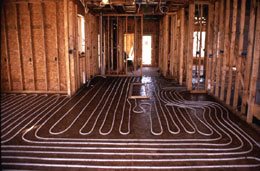
Another solution to the heating problem is to use baseboard heating.
Yes, a lot of this is rambling, trying to at least get ideas onto 'paper' as it were. But I wouldn't mind some outside input either, to know if anyone has even heard of doing this and the possible logistical difficulties with any of these plans. A lot of people push you towards forced air because you get 'free' cooling, but we plan on essentially passive cooling by designing our roof to block the sun in summer and planting the appropriate trees to increase that level of blocking.
So again, still mostly in the planning phase for this but trying to come up with a realistic solution is quite varied and they all have pros and cons.
Wednesday, September 19, 2012
Geothermal Infrastructure Considerations
Besides the cost considerations I mentioned in my last blog post, there are also infrastructure considerations to take into account with geothermal. Do we want to bother with ducts and forced air? Or do we just want radiant heating
(floor or otherwise)? If we want to take advantage of a geothermal
system's ability to air condition, we would have to have ducts. But do
we even actually care about that?
I have never had A/C at home (save for that one summer I lived in a desert), and I have to say I don't particularly care for it. There are only a handful of nights out of the year that I feel really uncomfortable, but for the most part that's only an issue when trying to sleep. When we get really desperate, we install a window A/C unit in the bedroom and that's sufficient. But even with the record high heat seen in 2012, we managed to get by with open windows and fans.
So right off the bat, if someone asked me whether I want A/C in my new house, my answer would be no. Even besides all the added cost and infrastructure required, I just don't even want it. I don't care about perceived luxury, or resale value. If I had an A/C system, I probably wouldn't even use it. I like having windows open and feeling fresh air flow through my house.
Which brings us back to geothermal. Half the reason why it is an advantageous system is because of the ability to reverse the cycle and air condition your house. If you were planning on replacing heating AND air conditioning with a geothermal system, then it's a total no-brainer. But really, we're only looking for an energy efficient, non-fossil fuel way to heat, not cool. Are all the costs ($, infrastructure) still worth it, then? If an entire geothermal system is comparable to the money costs of just heating, then it's not completely off the table yet. But if it's going to be more expensive money-wise on top of the added infrastructure (ducts, etc.), then I think we might want to explore other alternatives - such as, just go with electric heat and plan for a substantial solar voltaic system to offset those high costs. This requires a lot more investigation, and some number crunching. Stay tuned.
In some ways, geothermal parallels the concept of converting to a hybrid vehicle so you can feel less guilty about driving an oversized, inefficient SUV. When really, I'd rather just have the smaller car that's efficient and gets better gas mileage to begin with. (Well, really I want a fully electric car, but that's a whole different ballgame...)
I have never had A/C at home (save for that one summer I lived in a desert), and I have to say I don't particularly care for it. There are only a handful of nights out of the year that I feel really uncomfortable, but for the most part that's only an issue when trying to sleep. When we get really desperate, we install a window A/C unit in the bedroom and that's sufficient. But even with the record high heat seen in 2012, we managed to get by with open windows and fans.
So right off the bat, if someone asked me whether I want A/C in my new house, my answer would be no. Even besides all the added cost and infrastructure required, I just don't even want it. I don't care about perceived luxury, or resale value. If I had an A/C system, I probably wouldn't even use it. I like having windows open and feeling fresh air flow through my house.
Which brings us back to geothermal. Half the reason why it is an advantageous system is because of the ability to reverse the cycle and air condition your house. If you were planning on replacing heating AND air conditioning with a geothermal system, then it's a total no-brainer. But really, we're only looking for an energy efficient, non-fossil fuel way to heat, not cool. Are all the costs ($, infrastructure) still worth it, then? If an entire geothermal system is comparable to the money costs of just heating, then it's not completely off the table yet. But if it's going to be more expensive money-wise on top of the added infrastructure (ducts, etc.), then I think we might want to explore other alternatives - such as, just go with electric heat and plan for a substantial solar voltaic system to offset those high costs. This requires a lot more investigation, and some number crunching. Stay tuned.
In some ways, geothermal parallels the concept of converting to a hybrid vehicle so you can feel less guilty about driving an oversized, inefficient SUV. When really, I'd rather just have the smaller car that's efficient and gets better gas mileage to begin with. (Well, really I want a fully electric car, but that's a whole different ballgame...)
Monday, September 17, 2012
Geothermal Cost Considerations
One of the systems we have been considering is geothermal. Basically, a geothermal system involves a series of underground pipes through which water is circulated and naturally heated, after which it is transferred to a heat exchanger to concentrate the energy and heat a home. In the summer, the process is reversed so that a house is cooled, rather than heated. (This is an overly-simplistic explanation; I plan on doing more research, just to satisfy my curiosity if nothing else.)
There are a number of reasons right off the bat that a geothermal system seems advantageous - especially because out where we will be building, natural gas hookup is not available. Propane is expensive, and will only go up in cost; plus I've never been very keen on the idea of having a big tank of propane outside of my house. Also, since we will have to drill for a well anyways, why not go ahead and drill/dig for geothermal as well? Plus, it's "green" and a pretty hot thing right now. Seems like a no-brainer.
However, there are some important cost considerations. Most obvious is the upfront cost of installing the system, which is quite expensive. Next, and perhaps even more importantly, is the ongoing cost to run the system - some of the numbers we were getting from vendors about how much electricity it takes to run the system were downright staggering. We also got some conflicting information in this regard - so this point in particular requires much more research.
Another consideration is the infrastructure of the heating/cooling system inside the house - but we'll focus on that in a subsequent post.
In the meantime: Have any of you done much research into geothermal, or perhaps have a system installed already? What have you found with regards to the electricity consumption required to power the system?
There are a number of reasons right off the bat that a geothermal system seems advantageous - especially because out where we will be building, natural gas hookup is not available. Propane is expensive, and will only go up in cost; plus I've never been very keen on the idea of having a big tank of propane outside of my house. Also, since we will have to drill for a well anyways, why not go ahead and drill/dig for geothermal as well? Plus, it's "green" and a pretty hot thing right now. Seems like a no-brainer.
However, there are some important cost considerations. Most obvious is the upfront cost of installing the system, which is quite expensive. Next, and perhaps even more importantly, is the ongoing cost to run the system - some of the numbers we were getting from vendors about how much electricity it takes to run the system were downright staggering. We also got some conflicting information in this regard - so this point in particular requires much more research.
Another consideration is the infrastructure of the heating/cooling system inside the house - but we'll focus on that in a subsequent post.
In the meantime: Have any of you done much research into geothermal, or perhaps have a system installed already? What have you found with regards to the electricity consumption required to power the system?
Subscribe to:
Posts (Atom)